I finally get my travel advance and my departure schedule. Though I will be the last one to be picked up in the morning, I still need to be there by 6AM. Oy!
I scribble a card to put on packages and get my act together to drive to a hotel where an acquaintance of a friend from Canada is waiting for package drop off (the package will be carried in his luggage from Kinshasa to Montreal). It's 6:09PM and I still haven't packed for tomorrow.
Stressed? Who me?
November 23, 2005


5:10PM
I get the money for partners, and the packages containing flipcharts, pens, pencils, sharpers, erasers are packed up. Due to weight restriction, we choose to pack an important computer and leave behind boxes of candles, matches, soaps and toilet paper. I manage to take 4 rolls of toilet paper for participants, three soaps for hand-washing for participants before meals, 6 personal candles and a few books of matches.
I receive the loan of an LCD screen for Powerpoint projections.
I also plan to pack candies (both hard and soft) for the last day. Surely, even grown Congolese doctors on the field like candies.
I receive the loan of an LCD screen for Powerpoint projections.
I also plan to pack candies (both hard and soft) for the last day. Surely, even grown Congolese doctors on the field like candies.
It's 4 O'Clock
in the afternoon and I should be leaving for an evaluation on the field tomorrow.
(1) I still don't have a plane ticket:
-I have been told I could either take a nice flight,
-A flight that has been banned by our organization, or
-I might be asked to stay in the office to work on a new proposal
-As a matter of fact, I have been told that I may be contacted by email while on the field, return early, travel all day by motorcycle, take an unsafe plane boack and leave the next day to Kenya. In that case, I will be packing a small backpack. Suckers don't know that I have no email access while on the field
(2) I don't have money for my trip and am still waiting to hear from finance before they leave at 5PM (on the dot)
(3) I don't have the thousands of dollars I am supposed to bring to the field--still waiting for finance
(4) I don't have the flipcharts, markers, pens, pencils, pencils sharpeners, toilet paper, soap I ordered three weeks ago for this evaluation
(5) I haven't gathered all my reports and read all necessary materials. Am doing that now while writing this post.
God, please help.
November 21, 2005
Holy Cow!

I'm not much of a hippy though I don't like to shave so I suppose I may have been one in my previous life.
I have never met anyone making their own yogurts--the weird thing is that I've had three separate conversations on yogurt-making in my 8 months of being in Congo. These relatively normal people seriously took me through the art of making a home-made yogurt.
Why, you may ask, do normal, down-to-earth, positively unJoplinesque people make their own yogurts? The reason is that a single, small, unflavored pot of yogurt costs...brace yourselves....$1.50!!! I can tell you're not shocked, but consider if you will, a weekly normal yogurt intake. That's about, what, 4 to 6 yogurts right? You are are paying 6-9 dollars for a bland, boring set of yogurts.
The first time I saw yogurts here, I was so excited (Senegal was definitely yogurt-poor), ran to the display fridge and proudly set my yogurts on the non-functioning cashier belt. Boy was I shocked when the cashier ran the price of the items...But I kept my composure, smiled idiotically while blanching and ran back home to hit myself in the forhead.
It's almost like cows are holy here. As a matter of fact, I'm never seen a single cow in the Congo, even during my visits to the field.
The next time, I bought one yogurt, manufactured my own (using an internet recipe) and let it sit for 24 hours. Excited, I tried it with a little bit of sugar, and was disappointed to find out that it tasted like baby puke. Ok so I've never officially tasted baby puke but I've baby-sat enough to know what it smells like.
A bunch of friends are considering having a BBQ in a few weeks with a live demonstration on how to make yogurts. A sort of Tupperware party for 20 somethings.
The hippies of Kinshasa are at it again.
Writer's Blog
I must admit that I'm a little wiped out by the whole Congo experience right now. There are so many little things happening around me that don't phase me anymore.
I think I'm scarred forever: I'm afraid I'll still be driving like a maniac when I get back to the States. I'll be counting and examining each and every bill for sign of wear and tear. I'll be locking my car doors and checking they are still locked 2 times before I walk away from the car. I'll be making sure to have little bills around to pay the various people helping with my errands. I'll be avoiding tap water like the plague. I'll refuse to do errands unless I feel like I'm ready to tackle the crowds.
I was having a long conversation about blogging and my sudden lack of interest in writing down my experiences with Diego and Lulu .
Lulu said: "So you're having Writer's Blog?"
What can I say? Yesterday, I found out that if I'm paying someone, the rate of change is CFA500 to the dollar, and if someone is paying me the rate of change suddenly drops to CFA450 to the dollar. My cleaning lady took my $10 for three tomatoes, 2 avocadoes, 2 carrots and some greens. I was quoted the price of $20 to decode my cell phone. My phone bill is astronomical.
We had a whole conversation on Air Miles and I'm proud to say that Air Miles are more complicated than a Johnny Cockran contract. Did you know for example that you get more Air Miles if you apply for a card from the United States than from France? That there is a secret form on the internet that allows you to add miles you may have forgotten without dealing with Air France Flight Attendants? That you can be up-graded without hassle for having a Silver status? That the attendants give you champagne before you board the flight if you are frequent customer?
Somehow, traveling seems so much less glamorous.
November 19, 2005
Smuggling Goods in Congo
You probably thought this post would be about the secret Congolese police and special smuggling techniques that my colleagues and I have used to transport diamonds across the border. Not so.
This is just a big thank you to:
-FloraJ and Em for sending some Halloween candies to our apartment in France (it was a federal offense for my mom to pick up the package on my behalf but she pulled the "my daugther lives in Congo" card and the mailperson took pity on her),
-Justine for sending me a book called "Wild Women!" that was just the right size to make its way undetected into the monthly DHL pouch
-Steve in Wisconsin for sending me a copy of the great movie of the story of Lumumba, wedged and hidden between pamphlets
-Stephanie and Vicky for sending some presents (still haven't picked them up) through an acquaintance that is coming to Congo for work
It almost feels like there's a postal system here!
November 18, 2005
Zombies
16 Nov 2005
It’s 5 AM and I’ve just had the most terrifying Zombie dream: think Betty White of the Golden Girls dragging her stiff, white body in your direction.
Except these zombies were superzombie. You had to get in a boat and row like mad because they were fast and they were mean. You could try to swim away if you wanted but the fuckers were excellent swimmers too. Everywhere you looked there was moaning zombies and you had to keep the presence of mind not to freak out at every turn.
The antidote was to carry around a navy blue floatation device or have a dry Kleenex in your hand. How weird is that?
It was very similar to the movie 13 Days Later which is, by far, the scariest movie I’ve every had the (dis)pleasure to see.
Work’s really been troubling me lately I think.
November 11, 2005
Health Activities
There's a cool article in the latest Time Magazine about Global Health and 18 Heroes working in the field of development: page 95 details Léon Kintaudi work in the Congo. Though he can rub people the wrong way (a good self-marketer and interested in image), the article is very interesting as it is almost exactly what our partners on the field do.
Though be proxy, it's nice to be recognized for the work we do.
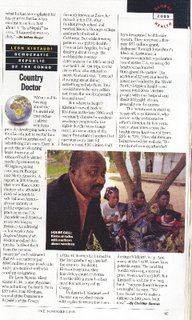
Time Magazine, november 7th 2005
(note: the picture is very poorly scanned but I encourage you to pick up a copy of the magazine if you are interested in the field of health and development
Though be proxy, it's nice to be recognized for the work we do.

Time Magazine, november 7th 2005
(note: the picture is very poorly scanned but I encourage you to pick up a copy of the magazine if you are interested in the field of health and development
November 08, 2005
WOW
To quote my brother: “so. much. work”
(his three-word answer to my long-assed email of two months ago-slacker)
I am overwhelmed with work. I am planning to get up at 5:30AM to work on a report, database and update my blog tomorrow morning. I swear, I'll do it. Uhem. But I must add that it’s sad when your comments become a lot more interesting than your actual posts (see comments on November 2nd post).
I would like to share with you an recent security email that I just received. I signed up for this security service while in Senegal to alert me on unsafe African areas one should avoid while travelling. This one came in a few days ago about France. Freaky.
SUBJECT: PUBLIC ANNOUNCEMENT -- FRANCE
1. This Public Announcement is issued to alert Americans
to ongoing security concerns in France. Significant unrest
that began in the northern suburbs of Paris October 27 has
now spread to several locations within the city limits of
Paris, and to many other cities throughout France. Angry
youth have set fire to many buildings and thousands of
vehicles. While damage to property has been extensive,
there seems to be no pattern of arsonists directing their
anger at ordinary citizens or tourists. This Public
Announcement will expire on December 7, 2005.
2. Travelers should be alert to news media reports for the
most up-to-date information, avoid areas where riots have
occurred, move quickly away from any demonstrations they
may encounter, and exercise particular caution during
evening and nighttime hours.
3. Travelers using the Charles de Gaulle Airport in Paris
should be aware that train service between the airport and
Paris runs through an affected area and has occasionally
been disrupted. Travelers should rely instead on airport
buses or taxis to downtown Paris.
[...]
6. Minimize considered.
I don't know what point number 6 means, but it sounds a little scary. "Minimize considered" **say in robotic futuristic voice**
November 02, 2005
Riots in Paris
There have been riots in Paris and though I don't follow French news very often (despite it being the land of my ancestors), riots are not hugely common in the country.
Although very sad, this does not surprise me (or anyone else I imagine) as societal unease has been building up into unresolved tensions between french citizens and immigrants. As I read this, I instantly think of my incident in the plane on the way from Paris into Kinshasa--which I have still to finish writing about.
Will update Welcome Back to Congo soon.
October 31, 2005
Day Three
Oct 29th 2005
Bas-Congo
On our way back to Kinshasa (“we’ll be on our way by 9AM, I promise” says my colleague) we manage to stop three times for food sold by the side of the road. By the amount of food that is rushed into our faces, I realize that, if Congolese people are starving somewhere out there, it’s not for lack of food—which makes me very sad that basic lack of infrastructure seems to be the main reason for people dying here.
At the first stop, we get Palm Oil for cooking which is cheaper and purer in this part of the country. I buy an snack called Mbika to hold me over until lunch. Highly work-intensive, Mbika involves pounding squash pits into powder and adding shrimp and water to make it paste-like and wrapping it into a large leaf. It has the consistency of firm cottage cheese, quite salty with a seafood bite and tangy. The kids look at me with interest through the window of the car, amused to see a white girl daintily removing the item for the leaf. I give them a thumbs-up after the first bite and they all burst out laughing.
At the third stop, I borrow money to get five avocadoes for 40 cents, 3 tomatoes for 20 cents, 5 large mushrooms (it’s mushroom season! I love it but get bitten by the pincer ants that guard the stems like precious bounty) for 60 cents and 4 small, white onions for 20 cents. Our bus quickly resembles a Congolese loading truck with Pondu leaves bursting from the seams.
We drive back in drizzle which turns into a thick white fog that obscures anything beyond 2 meters ahead, making it perilous to overtake trucks on the narrow road. We watch with horror the aftermath of one truck after the other, spilling people and their loads after violent accidents. Thank God we have a cautious driver! The drizzle turns into cold rain, dragging dust and trash from the corners of the stores and settling them in muddy puddles in the street and sidewalks: I know I am back in Kinshasa.
Day Two
Oct 28th 2005
Bas-Congo
The day beginnings with a recap of the previous day’s activities, by a participant who starts: “On this day of the 27th of October, the participants proceed to blah blah blah. After a cursory introduction and word from blah blah blah”. I’m a little surprise by how formal the recap is but need to remind myself that this job is taken very seriously by the man who came to the meeting to represent his community—besides his counterparts, the others are all highly trained doctors with public health degrees.
By mid-morning, we settle in a routine of two “Pause Sucree”, lunch, lots of talking, some snoring and generally just trying to evaluate the project’s progress of the last year.
One of the topics discussed is how to make projects and health structures conform to minimum government standards. I then learn that, while religious sisters are an amazing asset to the country (a lot of the functioning hospitals can give credit to their impassioned and relentless work), they are also a double-edged sword: most Congolese doctors like to work in the well functioning hospitals of the sisters, but put themselves at odd with the Ministry of Health as sisters often completely disregard governmental standards. And in part, this is why they are so successful.
The waitress at lunch is very worried for my welfare (“what is the white girl going to eat?”) and I assure her that I’ll eat whatever anyone else is eating.
In the evening, we have a little party for a colleague who is leaving, involving even more soda. Feeling bloated and increasingly guilty that I’m replacing my aerobic classes with sweet drinks, I go for a beer instead. I spot a lady with a very becoming pagne: it consists of a shirt with very puffy sleeves (think Victorian Era sleeves here) in a rich blue color and the perennial long skirt. I lean over to my neighbor, asking him “whoever is that man whose face is plastered all over that pagne over there?”. He explains that that is Kasavubu, the first president, and people wearing his image belong to a sort of peace movement. Its supporters admire his honesty and try to emulate his calm manner. I shake my head in agreement, effectively realizing that I know practically nothing about this first president whose mandate lasted 4 years and feel ill at ease seeing him in an army uniform, staring at me from the lady’s arms, thighs and bosom.
That evening, we eat what I assume is Kedgeree (a South Africa dish made from curried hard-boiled eggs, fish and rice) but in essence is rather tasteless. After yesterday’s pasta and cabbage extravaganza topped with egg to resemble an upside-down bowl, I am inclined to think that the old Belgian sisters are adorable, but just plain terrible cooks.
Day One
Oct 27th, 2005
Bas Congo
Being on the field is always so cathartic for me. Here I was in Kinshasa, working in a hot office with very sporadic electricity, sending in one report full of mistakes after the other, generally bemoaning my fate as office Dilbert, when we set off for Bas-Congo. Then I suddenly remember why I’m in this country in the first place.
Our trip begins with a colleague picking up fried dough balls for his breakfast, that he dips into hand-made peanut butter (they call it “Pate d’Arachides” or Peanut Paste). We also take time to change our American dollars to Congolese Francs on the street, taking 10 mins to count the wads and wads of cash to make sure no bills are missing. Bas-Congo it seems, deals in Congolese Francs instead of dollars.
Barely 20 minutes out of the city center, we see mud huts with straw roofs. The women are braiding each other’s hair outside, pounding manioc leaves and hanging their clothes out to dry on the thatched roofs. I can’t believe people live like that in Kinshasa. It’s like having a village in the middle of a city. No pipes, no wires, not even corrugated iron roofs.
The drive there is only 2 hours but Bas-Congo is a pleasant change from the polluted, overpopulated, irritating capital. It has a pretty impressive Cathedral (the first one built in the country) and interesting buildings left behind by the Belgians.
The landscape is rolling, green hills. The word “rolling” is such a cliché, but I swear sometimes it looks like one wave of hills rises and crashes to reveal others in the background, each with a different luscious, fresh color. The hills are interspersed with tall, emaciated Palm trees with splayed leaves—sometimes I have to blink to remind myself that this is not the Jurassic Era, stop looking for dinosaurs.
Being relatively close to the capital, Bas-Congo has reliable electricity and running water! There are some decent roads and bamboo fences. I see working computers in offices and even spot a Cyber Café. I see improvised hair salons outside with stylists that dry their client’s hair with hair-dryers. A colleague jokingly calls this place Little Belgium. Funny thing is that not one Belgian is left living there except for about 6 religious sisters that speak Flemish and have been there for ages. Many of these sisters will be buried on Congolese land, having lived there more than half their life with no family left in old Europe.
We work all day, stopping to eat lunch at an old Printing press which still has operational machines and little old men with glasses on the end of their noses working the heavy and intricate machinery. I notice with glee, that Chikwangue is plentiful as is cold bottled water. Even the Pili Pili has an especially tangy taste to it.
During our workshop, in trying to identify the factors of some poor performances in the regions, one presenter states hemorrhagic fever as one of the factors, reminding us how close we are to the Angolan border. I gulp and try to focus on the task at hand. The “Coffee Break” turns out instead to be a “Pause Sucrée” (Sugar Break) with Coca Colas, Fantas, Sprites, freshly grilled warm peanuts and nice biscuits that have the off-putting name of Glucose.
I might have mentioned this already, but I have never drunk so much Coke as in Africa. For some reason, I always feel severely dehydrated when I travel in-country, feeling the salt, sugar and ions literally drain out of me…I swear this is true. And there’s nothing like a sickeningly sweet drink to cure it. It’s strange how you can find Coke pretty much everywhere, even in the most enclaved regions. If we could capitalize on Coke’s distribution strategy, I’m pretty confident we could give anti-malarial to every single pregnant woman in Congo.
In the evening, I spend one hour moping the floor with the night-table tablecloth, after I unintentionally flood the little room with shower water. I am very embarrassed, thinking that perhaps the shower is just there for decorative purpose or else worked in the 60’s but was no longer functional. Running water seemed too good too be true I suppose.
I am now writing this (with no need to rush as there is electricity. Yeah!) in my small but very decent room, listening in on the sisters’ mass and unintentionally mumbling the prayers along with them. Despite the differences of regions, there’s comfort in recognizing customs. I guess that’s why American like Mcdonalds.
How to eat

How to eat chikwangue
Step 1: Buy chikwangue wrapped in leaf. Step 2: Unwrap leaf. Step 3: Cut and enjoy with Pili Pili

How to eat mbika
Step 1: Buy mbika wrapped in leaf. Step 2: Enjoy

The view from inside our dark workshop room. Needless to say, it was hard to concentrate on the topics discussed.

Beautiful, intricate church in the middle of the Bas-Congo

By the end of our trip, our little bus was transformed into Pondu (Manioc leaves) heaven...

But our load was not as impressive as this guy's whose bags were packed higher than the size of the entire car
October 24, 2005
Bumbo Lumene

The steep climb to the bridge

Rickety bridge itself

View of our Camp Ground

A cluster of butterfly on the shallow end of the river

Enchanted forest maybe?
Heaven and Hell are just 150 km apart
After driving for hours in the heat of Congo, in a large Jeep with no A/C, slaloming between dozens of broken down trucks gesturing for us to stop, paying a couple of bribes or two or three, we get to Bumbo Lumene. Paradise.
The camping is exquisitely well tended to by the Government (admittedly, one just has to brush the camp grounds and add a few twigs to the bridge--but still, I'm impressed).
I am not joking this is what we did:
-sat on rocks jutting from the river surrounded by fluttering butterflies
-cooked a pretty damn good BBQ with minimal effort (two workers started the fire for us)
-jumped at the top of the tributary, let ourselves be guided by the strong current, only to be gently deposited on a small beach... 10 times a day for two days
-crossed the rickety bridge squealing in fear every time and acting like Indiana Jones
-read the New Yorker on a pania while listening to the bubbling of the river nearby
-got woken up in the middle of the night by a loud AAAAAHHHHHH and wondered for two hours what the f*&# that was and thinking "What the f*$# am I doing camping in Congo, I could be killed by a madman with a machete" (somehow that was a lot scarier than being killed by a madman in the states with a gun--the shout turned out to be a fellow camper having a bad dream)
-washed dishes with the remainder of the ashes from the fire
-walked in a spooky forest of gnarled trees
-climbed a steep plain to see what was on the other side, only to give up after a little too much sweating
Ah, heaven!
The drive back was utter hell again--though we did see the bridge that was blown up by Mobutu to prevent Kabila from reaching the capital. How can Heaven and Hell be separated by only 150 km?
For another account by a fellow camper, check out Because We're Here
*************
Thanks Hasnain for posting on my GuestMap! How goes it in India?
October 21, 2005
The Other Congo
Congo-Brazzaville is a bit of a myth for us living in Congo-Kinshasa. It's a little like the lost Garden of Eden. My colleague who have been there tell me that there are real taxis; life is calm, cool and relaxed; there are roads, landlines and great restaurants. It's a bit of aberration because the two capitals are so close to each other yet so different in term of development. The people are meant to be well behaved and a lot less intense then here. And of course, Brazzaville is a much smaller city than Kinshasa, so there are less people crowding the place.
We often speak of the day when we will organize a weekend trip to famed Brazzaville. One day...one day...
So, in the other Congo, things are happening. The ex-president of the Republic of Congo, Kolelas, is currently living in exile in Bamako, Mali.
Why?
"In 2000, a Brazzaville court sentenced Kolelas to death in absentia for a range of crimes committed by his militia including torture and the rape of prisoners during the nation's bloody 5-month-long civil war in 1997."--CNN.com, October 14th, 2005
Recently though , Kolelas' wife, Jacqueline, died from a brain hemorrhage. The current president Denis Sassou-Nguesso (who got elected in a fair process in 2002) allowed Kolelas to come back from an 8-year exile to bury Jacqueline in Congo-Brazzaville.
But of course, it's a lot more complicated than that because:
Kolelas' return comes amid a sharp escalation of tensions in Brazzaville, where so-called Ninja rebels once loyal to him battled security forces a day earlier in a brief clash that killed six people.
It was not known what sparked the clash or if it was related to Kolelas' impending return.
--CNN.com, Friday October 14th 2005
We were discussing this situation over dinner yesterday and a friend relays that her colleagues exclaimed "We're not surprised this happened, the Congolese over there, they're really crazy"!
October 20, 2005
Car Wash
This morning, a little old man had cleaned my car assiduously. He rushed over when I came down, bending my wipers back in place to indicate that he'd been working on the windshield last.
I shook my head in apology, explaining that I couldn't pay him and thanks but I didn't ask him to wash my car and that we had someone at work who did that for us and...I fumbled, feeling sorry for him but at the same time didn't feel right giving someone money for a service that he forced upon me.
He had cleaned my car earlier in the week without my prior approval and I gave him money but said that he should never clean it again because I wouldn't pay him next time.
Makes sense doesn't it? Then why do I still feel bad about the whole encounter?
Subscribe to:
Posts (Atom)