September 14, 2005

Pictures of Kole


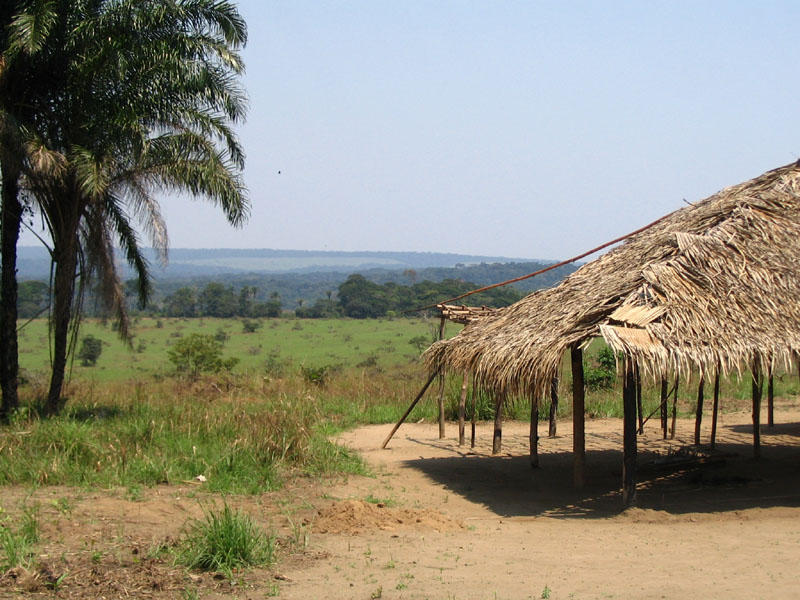
A view of the little town of Kole from the 2-seater airplane


A view of Kole behind a shaded veranda.


Moms await their turn to be vaccination for Tetanus under the shade of umbrellas. In some regions, mothers refuse to be vaccinated, fearing the vaccine to contain powerful sterilizing ingredients. This center attracts dozens of women by sensitizing the community.


In the forest, women walk to their cultivated plots to gather the manioc. The “Maman” swiftly peels the thick bark of the tuber with a machete before setting it in her backpack. She shows a large goiter due to iodine deficiency in her diet

Kole 2


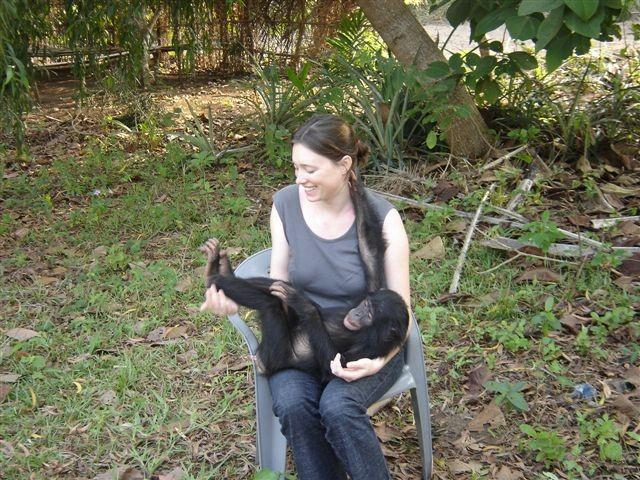
Bond and Bonobo (Antonia) bonding...


A nurse shows me where manioc is pounded into flour to feed the malnourished children. Manioc has no nutritional value—but their diet with be supplemented by Pondu and a little bit of meat, bananas.


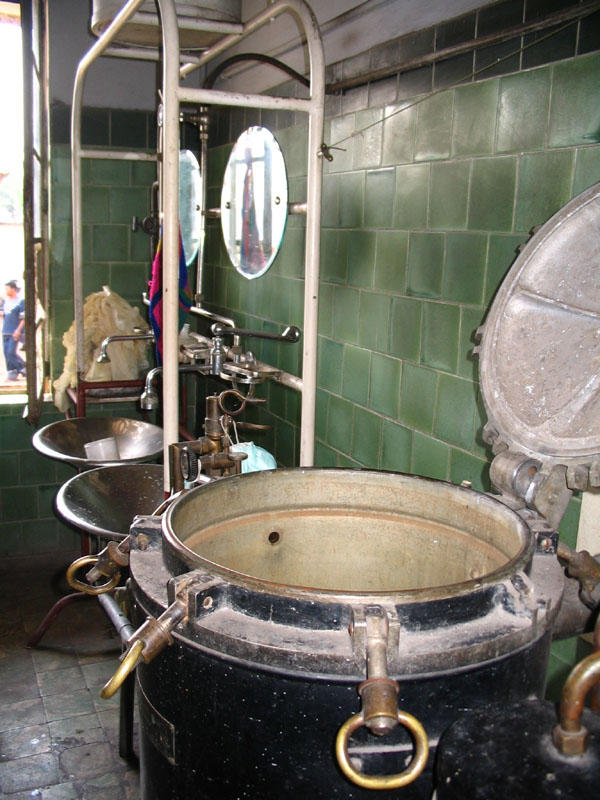
A corner of the nicest hospital of the region. The sinks don’t work since there is no running water. In the foreground is an old autoclaved machine used to sterilize syringes and other equipment fired with coal.


An old woman sits outside the waiting room, awaiting treatment. She has facial marking that can be seen on a few elders of the region. She is holding her weaved backpack to bring back medicine.

September 12, 2005

Videoblogging

Does anybody know anything about videoblogging? I tried to look it up but it seemed terribly complicated, especially if you have a sloooow internet connection.

Thanks for the info computer gee...computer experts!

PS: I would really like to post some of my friends retarded Congo Adventure videos

Yikes! More Airplane Crashes!

Check this out from Carl the Pilot

007 Don't Read This

September 08, 2005

Hurricane Katrina

I was on the field when I heard about the hurricane. Luckily I was in Lodja by then and we watched at bit of news powered by high-priced gasoline.

From the little I understand, there were a set of circumstances that went wrong: terrible weather, logistical difficulties, poor planning, lack of leadership and just general poor luck. Did I get the gist of it?

It saddens me that the United States, a country with some of the best infrastructures and emergency equipment in the world, couldn't get a handle on the situation, despite knowing AHEAD of time that this disaster would happen.

Perhaps the government should hire Emergency Coordinators from International NGOs in such situations?

I'm confused.

Humbling Luggage Experience

Today I brought my luggage to work because I had a lock that just wouldn't open (cheap piece of sh*** from Senegal). My Admin guy comes with a pair of sharp scissors and says "I don't want to worry you but..." then he jimmies the zipper with the end of the scissors and opens up the seam to reveal the content of the suitcase.

Yikes! Now I understand why people in Africa bind their luggage with layers and layers of duct tape--this discourages a carrier from illegally searching the luggage. I had assumed the suitcases were busted and were held together by tape.

Next, he gave a little bang with the end of the scissors and pushed the loop of the lock, and it springed open, gutted with the small inside-spring hanging on the outside.

What the heck was this guy's job before he came to work for us? He just laughed when I asked him the question.

4 Sept 2005

Day Seven
Lodja


I decide to go to church in the morning despite my body protesting that I still need sleep. The church is a rather simple building where villagers gather to celebrate mass in Tetela (the local language). Though I understand nothing, I can see that the priest is very charismatic and makes his audience laugh. Then the choral starts singing accompanied by local drums carved out of whole pieces of wood (they don’t have the characteristics skin stretched over them, they are made from hollow rectangular wood). The voices of the young women and men rise up, followed by the droning voices of the elders, the music amplified by the building, sounding louder than a nirvana concert. Looking around at those people who have been pillaged and hurt, wearing their nicest clothes (at best the clothes are distended and slightly discolored, at worst they are not wearing shoes), nursing their babies—the ones that haven’t died of malnutrition and diarrhea, their voices clear and bold, swaying to the rhythm of the drums and the choral and I suddenly feel this burst of emotion and have to step outside before I burst out crying..

I cry and cry and cry some more, probably due in part to fatigue but also due to pent up emotion. I am ashamed of my self-doubts, my wanting to go home because it’s too hard. But mainly, I touched by the sheer strength of the Congolese people: standing so straight and singing with such power. It seems that no pillaging, no lies, no poverty is going to break their spirits. After church, we set off outside and proceed to shake everybody’s hand in a line that curves around the building.

A few expressions I learned along the way:

Republique Democratique du Congè
Democratic Republic of Vacation

Comment ca va? Pas plus que vous (no better than you)
Q: How are you doing? A: No better than you

Comment ca va?Au rythme du Pays
Q: How are you doing? A: As well as the country is

3 Sept 2005

Day Six
Lodja


We are broken and we are tired. I discover the true meaning of the word tired—dog tired, exhausted, beat, worn out, bushed, pooped. My whole body aches and I am morally drained by seeing hospitals with no doors and windows, patients on weaved cots and no sheets and lack of water and electricity in General Hospitals.

We wake at 4:00AM to set of at 5:00AM for our trip back from Kole to Lodja.

The Bishop is kind enough to offer us a ride back to Lodja in his car. It is filled with a Bishop, a nun, a doctor, a mechanic, the driver and me. Being the only one with no valuable function in case of an emergency, I try to make myself useful by snapping loads of pictures. You never know, it might come in handy if National Geographic wants to hire me (hint hint). Again, the trip is quite difficult and we stop 1 hour after our departure to find a huge old truck, stuck in the middle of the road (in essence taking up the whole width of it). It seems its battery ran out. We lend them a little bit a juice but the motor has been so modified, welded and haphazardly fixed that it takes a while until it can be powered again. We set off on our merry way, making the best of the up and down, side to side movement of the car until we find a tree in our way.

The driver gets his ax, the mechanic his machete and they set hacking at it until it can be moved to the side. Back in the car, the sister mumbles “sweet Jesus!” every time the car dips to a 45 degree angle (the two front wheels being at severely different height, it feels like we are going to topple over). I see men carrying dead monkeys and antelopes up to the markets. I see woman with weaved straw backpacks carrying banana leaves, baby, manioc, and pondu (manioc leaves) back to their villages from the forests. I see thousands of butterflies that flitter at the approaching vehicle, bursting their clutter into individual petals of color. I see the Independent Electoral Committee vehicle pass us by and give them two thumbs up for the job of enrollment they are about to do in Kole.

We get out of the car three times to push it up a slope. We even find ourselves filling up a hole to help it get traction on a particularly problematic hill. We get to Lodja just before the rain starts pelting down with fury (imagine the clay road becoming a thick muddy river bank when it rains) and I throw myself on the bed to sleep.

1 Sept 2005

Day Five
Bena Dibele


After having worked in Kole for a few days, we leave the city towards Bena Dibele, It is a tiring 3 hour motorcycle ride on roads that are barely passable. Bena Dibele used to be a rather important port in the area but since the pillaging by Rwandese soldiers in 2001, it is bare. Nothing is left in the city but a religious brothers’ residence and village huts. During the whole trip, I hear stories of how it used to be before the war. Even the Bishop’s place was completely trashed, his religious objects sold for pittance, his motorcycle and fuel used to terrorize the remaining villagers while the rest of the population (along with a Spanish sister who has been here for 25 years and the Bishop) were living and hiding out in the forest for months. We pass two bridges that were built around the time of the colonization, in the 1950s, that are still holding up admirably well.

After the 3 hour ride, we immediately set off to work visiting various health structures. I feel like a zombie and look worst I’m sure. All I want to do is go to bed and sleep, but I know these people haven’t been visited for a long time, and my visit gives them something to look forward to. The structures are adorned with leaves and flowers for our arrival and I just can’t bear to let them down. We go back to the brothers’ place after our long day to eat and sleep. I take a shower and marvel at the running water there (they have a cistern on the roof) and notice light switches everywhere but no electrical wire to connect them to the dangling light bulbs. Even if the electrical system did work, they wouldn’t be able to purchase the fuel necessary to power the house.

The next day we get up early, go visit another health structure, set off for the return trip of three hours and work some more until 11:00PM.

August 31st, 2005

Day Three
Kole


The morning, we visit the General Hospital. Having seen 4 or 5 in Congo so far, I have to say that it’s the most impressive. It offers the following services: internal medicine, basic care and treatment, family planning, a maternity with an echogram, radiology, surgery (a woman was even recovering from a mastectomy), a nutritional center for malnourished children, a garden where families of long-term patients could work to make a little bit of money to feed their family members and where the resulting crops where used for the nutritional center, a blood bank (requires electricity for the fridge and willing volunteers) etc…

It is run by a bunch of really energetic missionary sisters who piece together all the money that they can get. Of course, the hospital is not without problems: it needs a serious paint job, it could do with better patient beds and needs mattresses, and there is no running water. Each patient for surgery is required to bring her/her own pail of water.

That lunch, we eat the customary rice, fufu and manioc leaves with antelope meat. I have two helping of the meat that is subtle and brittle. Sooo good. We come to talk about how isolated the health zones of Kole are: two bridges are out requiring a pirogue ride to the other side (imagine motorcycles in swaying pirogues), roads are so shoddy that jeeps cannot pass there. Freight boats are highly unreliable, they take three months to navigate a short stretch of the river due to weak motors and overcharging. Boats even take entire families on them. Since a boat is often way behind schedule (it takes 3 months to get there as opposed to the optimistic “oh it’ll only take 3 weeks”), many family members die on the way from sickness or starvation.

August 30th 2005

Day Two
Tshumbe, Kole


We first attempt a flight back to Tshumbe. It is eventless this time around. The landing strip is in pretty good shape, with tarmac-like material on the ground. I marvel at it and am told that dark termite mounds are crushed and packed on the ground producing a very firm surface.

Next, Jacques, a Congolese pilot trained in the states, takes us in his two seater plane. We fly over miles and miles of thick forest, punctuated by short strips of orange villages. Those villages are truly isolated. The landing strip is less than a kilometer long, paved by sand and its obvious only the small plane could have made that landing

That night, we stay at a religious house with the only guest house in the village. It has running water, a mosquito net and even electricity for 3 hours in the evening.

September 07, 2005

August 29th 2005

Day One
Kinshasa, Tshumbe, Lodja, Kananga


The day starts off early with a departure on a small 9-seater plane. The pilot is cheerfully loading our medicines, chainsaws, microscopes, laptops and luggage in the cargo space.

We are to flight to Tshumbe to leave off three of our colleagues, then my fourth colleague and I are meant to take a 2-seater plane to Kole. The trip is pretty uneventful until we spot the tiny Tshumbe airstrip 3 hours later and wispy clouds indicating strong winds. The pilot attempts to get closer to the strip when the plane is jostled and almost sucked into a storm. We can’t seem to establish radio contact (the only radio in Tshumbe was closed due to the lightning) and we set off for Lodja where we hope the weather is better. By now, the bad weather has spread pretty much everywhere and the jostlings of the airplane are like being on a rollercoaster—that sensation of momentary weightlessness when your heart feels like its going in your throat. Expect roller coasters are designed to do that…and planes aren’t. We can’t establish radio contact with Lodja either and are forced to land in Kananga.

After the customary trouble with immigration –who wants us to pay $20 for each new arriving white person and $30 for each pilot—we go to the only restaurant there and finally eat our lunch at 4:00PM. It looks like we are going to be staying the night there. That evening, the pilot lends me his GPS so I can figure it out: he wants me to map out the Tshumbe and Kole airstrip. At the moment, the two tiny landing strips are not marked on the GPS maps and they do not feel comfortable landing there on a regular basis without some basic information. His handwritten notes sort of look like this:

August 28, 2005

Cool Blogs

I have just added some blogs that link to me on the side bar --->

The blogs are all pretty damned cool so I'm terrible flattered to be linked to them. Although, their content does considerably improve by the mere mention of my site :) :)

("Modesty--thy name is Woman", or as my dad would say "If I were modest, I'd be perfect")


PS: I have not asked for permission to link to some of the site here so please let me know if this is OK by you
PSS: Let me know if I forgot any links!

August 27, 2005

Ying and Yang

Post to come on Immigration Troubles and Redeeming Speech


******
Thanks for Lulu on the Bridge who is blogging from the Congo too and Black River Eagle (aka Bill) who has a great compilation of various blogs.
Also, thanks for all the comments I have received and not answered (like the interesting comments about the spiky hairstyle, the gecko on the windowsill that happens to be real, the encouragements from various people I don't know and those from people I know :)
I am still at work on Saturday and planning to be here on Sunday to prepare for my next trip on Monday to Kole. Sigh, so much to do, so little time. How do people do it? I just don't know.

August 26, 2005

Makota

August 23rd

I have to hurry writing these few words as my computer is out of power and lights are going to be turned off any minute now. I had a long day but I managed to sneak out a lunch, go to the main market with a sister, buy some fabric and bring it back to the sister’s seamstress for a Pagne. I hope to get it sometime tomorrow or I might have to leave without it!

I went to visit a hospital, and though I had to pay close attention to what the lab tech was saying and take notes, I couldn’t help sneaking glances at the frightened and despondent parents who brought in their listless child. The mother was attempting to fan her child and rock him but his body was flopping in her hand (imagine a rag doll), his eyes bugged out and letting out tiny hiccups that were attempts at crying.
I also went to visit the Central Bureau in charge of administrative issues for the Health Zones. As yesterday’s, there were no windows or doors, the building was completely dilapidated. It’s really demoralizing when the Doctor Chief of Zone says that he hasn’t been sending his last reports because his typewriter has been out of service for the past three months. We told him a hand-written report would be fine but how do you encourage someone’s who’s job is considerable, to work in such conditions? It’s embarrassing.
Tonight, I have the beginning of a migraine and I hope that the night will bring me hope and enthusiasm for tomorrow and the day after that, and the day after that. My biggest fear is that we are doing absolutely nothing that is helping this country and this is looming larger and larger in my subconscious (I get terrible nightmares while on the field).

Kanda Kanda

August 22, 2005

I have an exhausting day of visiting health structures in the area of Kanda Kanda. Though the area is only 2 hours away from Mwene Ditu on a relatively good road, the trip is exhausting and by the time we get back home after having skipped lunch, we eat like we’ve haven’t eaten in days. I chow down on rice, pondu (manioc leaves) and termites which the hostess has prepared after she hears I am fond of them.
The day was packed and full of discoveries but the hardest one was to witness of young mother who had discarded her child after its birth. She was lying on her cot next to her sweet sleeping child, looking scared and lost. Outside her door was a policeman keeping an eye on her, because she was considered a criminal. I couldn’t help shuddering, thinking about the millions of other more dire needs for a policeman in Congo.

That night, I struggle to stay up past nine but force myself to watch the French news on TV5. What do you make of a famous shoe company laying off workers in France, forest fires in Portugal, floods covering the bottom levels of large buildings in Romania, damaged US planes sold to developing nations, a lady receiving a $253,000,000 settlement for the Vioxx-induced death of her husband, the new google feature that finds detailed images of geographical locations, the best tourism spots in the world and the new Rolling Stones concert; when you’re a nun in a diamond mining town of Congo?

Sisters (2)

August 22nd, 2005

The breakfast is copious and I notice a cream cheese-like item that, I’m told, is a cheese made from powdered milk. A sister promises to write down the recipe after her day at the hospital. She is wearing a knitted vest that has been made by a “Maman” of the village. I take a shower with cold running water and marvel at how much better off these sisters are than those in Luiza. I talk to a sister of Spanish origin who has been here since 1971. She is quite talkative and laments the fact that the country’s situation hasn’t changed since the time of Mobutu. I ask her if any of her family has come to visit, she answers that her living relatives have been talking about it for a while but that there would be nothing for them to do here. The country has been very reticent to accept tourists and back in the day, one had to bring a large amount of cash (about US $1,000) and show a budget of expenditures before returning home. No wonder no one came for a visit!

The Sisters and Television

That night, I stay at the sisters’ house where the dinner is taken communally. Though I have a little room much like any other in a Congo nunnery, this is definitely a high end convent: the place houses 17 sisters with constant guests that come from NGOs, locals who go there for dinner and Congolese visiting sisters. Four of the sisters are European, one of which (originally from the Iles de la Madeleine in Canada) has been in Congo since 1965. Having spent more time in Congo than anywhere else, she has not been able to register for voting since she doesn’t have Congolese nationality.

A group of 20 people sit around the television to watch French news on TV5. Images of the painful Gaza strip withdrawal, the privatization of France’s roads, soap car races in a Paris park, celebration of Australia in a local zoo (drawing hoos and haas at the sight of a baby Kangaroo) and Dom Juan playing at the theater. It’s so odd knowing that I am in the middle of seemingly nowhere and television connects sisters who have never left their village to people from all over the world. French news seems so irrelevant and dramatic here yet it’s comforting to know that the outside world is still spinning. I wish I could switch the polarity of the television so that the newscaster and French families sitting on their couches could see the sisters watching them with avid eyes.

I feel like I’m in college again.

Mbuji Mayi (Boo-Gee-Ma-Ee)

August 21st 2005

We arrive in Mbuji Mayi after a short, uneventful flight. The view from the air reveals shallow clay canons, a sprawling city with corrugated iron roofed dwelled interspersed by palm trees. Once again, I register the wonderful greenness of it.

Navigating through the airport proves to be a little too much for me, with officials coming in and out of the waiting area with my passport (making me very nervous) and a long discussion about why I had to pay the special $50 + Fr 2,000 fee: for all first-time foreigners there’s a special fee, but since I am working in the humanitarian sector, the official would be willing to reduce the price considerably. Would I be able to pick up the passport tomorrow to fill out paperwork? No? Well then I could just pay him right here and now and all would be over with.

When we explained that the fee hadn’t been budgeted in our planning and that we needed to call our boss for confirmation, the affable official says that he can waive the fee this time around but I would have to pass by the customs office located in the middle of town.

I am fuming but trying hard not to show it. It’s so discouraging to be asked for a bribe each and every time I arrive in a new airport; it’s enough for me to want to go home and say “screw it, I’m going to help no one but myself”.

The drive from the city of Mbuji Mayi to Mwene Ditu is very pleasant and I have time to notice striking differences with my trip to Luiza. The road is 130 km and it takes us only 2 hours to get to destination! Compare that with the 150 km of the last trip to took about 8 hours to complete. The road is quite nice, actually paved all the way with a few tricky spots that involve having to drive around the potholes.

There are businesses everywhere and you can really get a sense that the city somewhat prosperous. I learn three things about the region:
-it is renowned for its diamonds and cookies. The diamond trade is prevalent with large drilling machines along the river bed and dozens of diamond cutting shops. Foreigners are not allowed to buy them of course. The city, though better off than its Congolese counterpart, should be a lot wealthier when you consider all the diamonds that are harvested there. The biscuits are produced in a factory close to the diamond club;
-the beer here is not Skol or Primus, it’s called Turbo King. Despite it’s name, it has the reputation of being watered down;
-one a hillside by Mbuji Mayi live the “refoulés de Katanga”. These are displaced peoples from Katanga during the time when Mobutu wanted to divide a state into two warring zones (?). The displaced have adapted quite well to the town as the people who fled were primarily highly skilled and educated who fled to the city where the only skills revolved around diamond harvesting and trading. They now own shops, training centers and technical industries (mechanics, welding, iron gates—useful when you consider how many places need to secure their diamonds).

August 20, 2005

Cloth

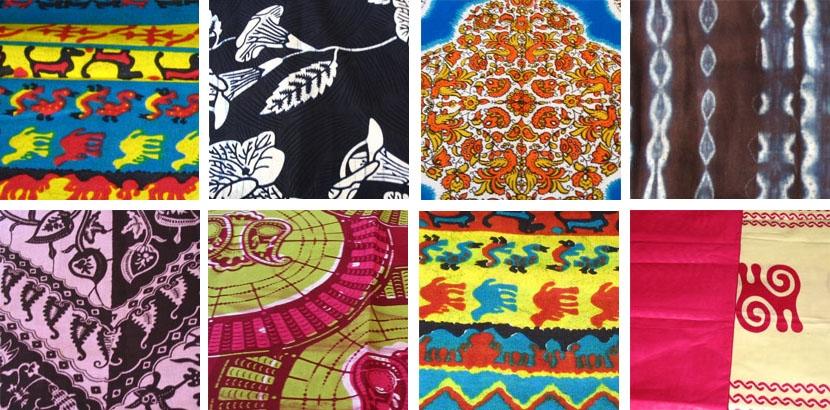
Because I like shopping and I've been in serious shopping withdrawal mode, I buy the only things there are to buy here: furniture, and tons and tons of cloth. Below is a sample of the many loud prints I found appealing. I cant' wait to go to a tailor and make myself some Pagnes (Congolese equivalent to Boubous).

My favorite ladies selling the clothes set up their wooden displays in an alcove by the side of the road, constantly bothers by visiting policemen (who impose bogus "fines" and make money off the business too). They charge a set price of 10 dollars for 6 yards of fabric. There's no bargaining and it's an absolutely wonderful experience... If you don't mind the sun, the dust and the ladies trying to draw your attention to their "unique" cloth (that happen to look exactly the same as the previous stall's).

In order to verify that this is good cloth, one has to watch out for the bottom tag marked "Guaranteed Veritable Wax-Top Final" or any derivative thereof. If you were to make a long skirt, you would make sure that the tag is visible at the bottom center of the dress so people would know you're wearing the real thing! Most dresses look weird to me, as have an unfinished quality to them with their unhemmed bottoms.

The image below contains fabric that I bought from Senegal, Guinea Bissau, Congo (but made in Côte d'Ivoire or European countries). Little known fact: most African cloth is actually fabricated in Scandinavian countries with designs created by African stylists. So the cloth I bought on the market is most probably made in Europe rather than in Africa. European cloth with African appeal.

I'm thinking about having an American grandmother make me a funky African quilt with the remaining fabric. Can anyone sew?

******

Thanks for posting on my Guest Map Eva Roca and San Marino or Bust!